Hear a knock, tick, squeal, or rattle? Here are 7 common engine-related car noises, what they usually mean, what you can check, and when to stop driving.
A check engine light can mean anything from “your gas cap is loose” to “stop driving before you cook the engine.” The trick is knowing which situation you are in without guessing or throwing parts at the problem.
I have seen plenty of cars towed in for an issue that started small and got expensive because someone kept driving with the light flashing, or ignored obvious warning signs like overheating. This guide walks you through what to do in the moment, how to pull codes with a basic OBD2 scanner, and when it is time to park it and call for a tow.
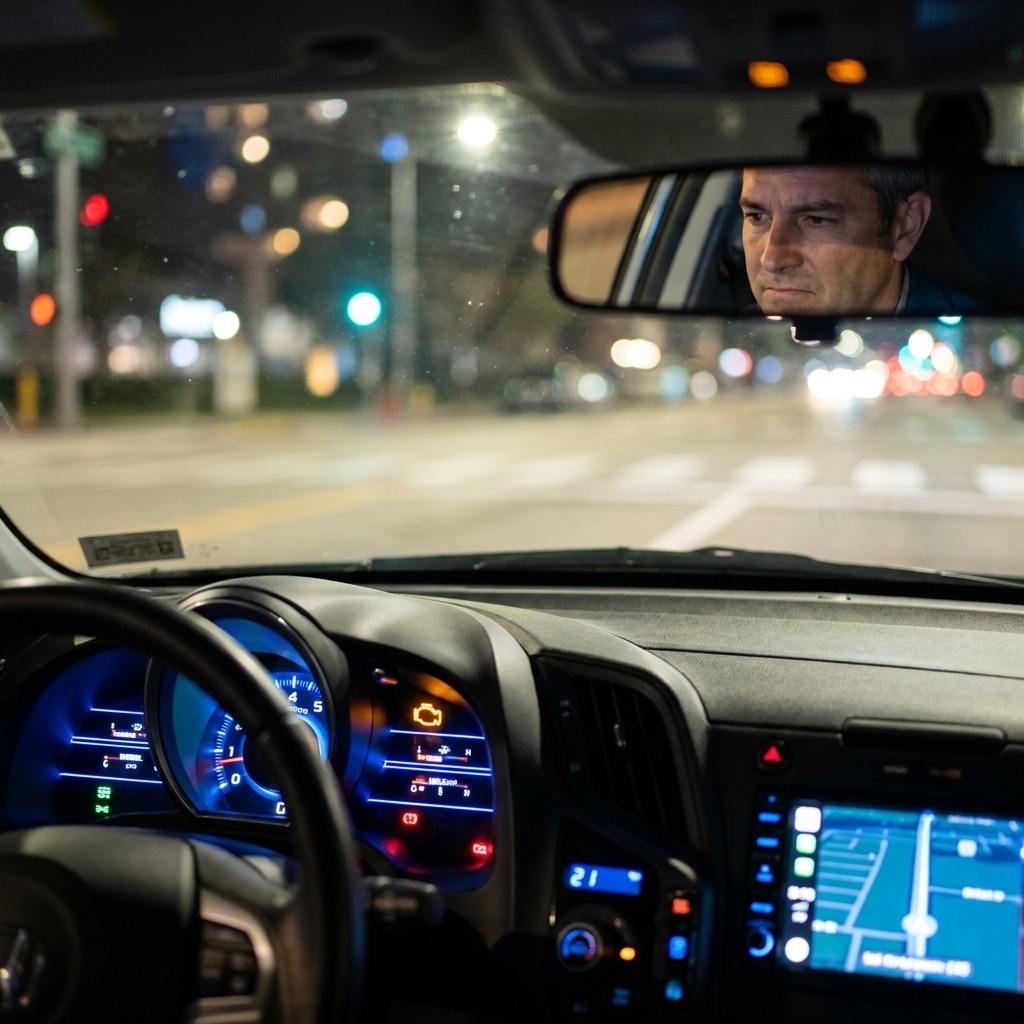
Step 1: Solid or flashing?
Safety first: If the engine temperature is climbing toward hot, you see an overheating warning, or you get a low oil pressure warning, shut the engine off as soon as you can do it safely. Those conditions can cause rapid, expensive damage.
Solid check engine light
A solid light usually means the computer detected a fault that can affect emissions or drivability, but it is often safe to drive carefully for a short time. “Safe” depends on how the car feels and whether other warning lights are on, so do the quick checks below before you commit to a longer trip.
Flashing check engine light
A flashing light is a bigger deal. In most vehicles, a flashing check engine light usually indicates an active misfire or another condition that can damage the catalytic converter quickly. That can turn a modest repair into a four-figure one.
- If it is flashing: reduce speed, avoid hard acceleration, and look for a safe place to pull over.
- If the engine is shaking, power is dropping, it is overheating, or you smell strong fuel or a sharp sulfur “rotten egg” odor: stop driving and arrange a tow. (Smells are not a diagnosis by themselves, but they are a reason to take the warning seriously.)
Note: Some vehicles also have a separate wrench light or “Service” light. Depending on the make, that may indicate maintenance due, a powertrain issue, or a reduced-power mode. If you are not sure which warning you are seeing, treat any flashing warning or major drivability problem as urgent.
Step 2: 60-second safety scan
Before you grab a scanner or start Googling symptoms, take one minute to check the basics. This is the same quick triage I do when a customer says, “It just came on.”
- Look at the temperature gauge: If it is climbing toward hot, or you see a red temperature warning, pull over as soon as it is safe and shut the engine off.
- Check for other warning lights: Low oil pressure, charging system, or overheating warnings should override the check engine light. Those can strand you or destroy an engine fast.
- Listen and feel: Is the engine running rough, stumbling, or vibrating? Does it have noticeably less power?
- Sniff test: Strong fuel smell, burning smell, or a sulfur odor can point to a problem that should not be ignored.
- Quick underhood glance: With the car parked and off, look for obvious issues like a disconnected intake hose or fluid dripping. Do not touch a hot engine.
If everything feels normal and the light is solid, you can usually drive home or to a shop. If anything feels “wrong,” treat it as urgent and limit driving.
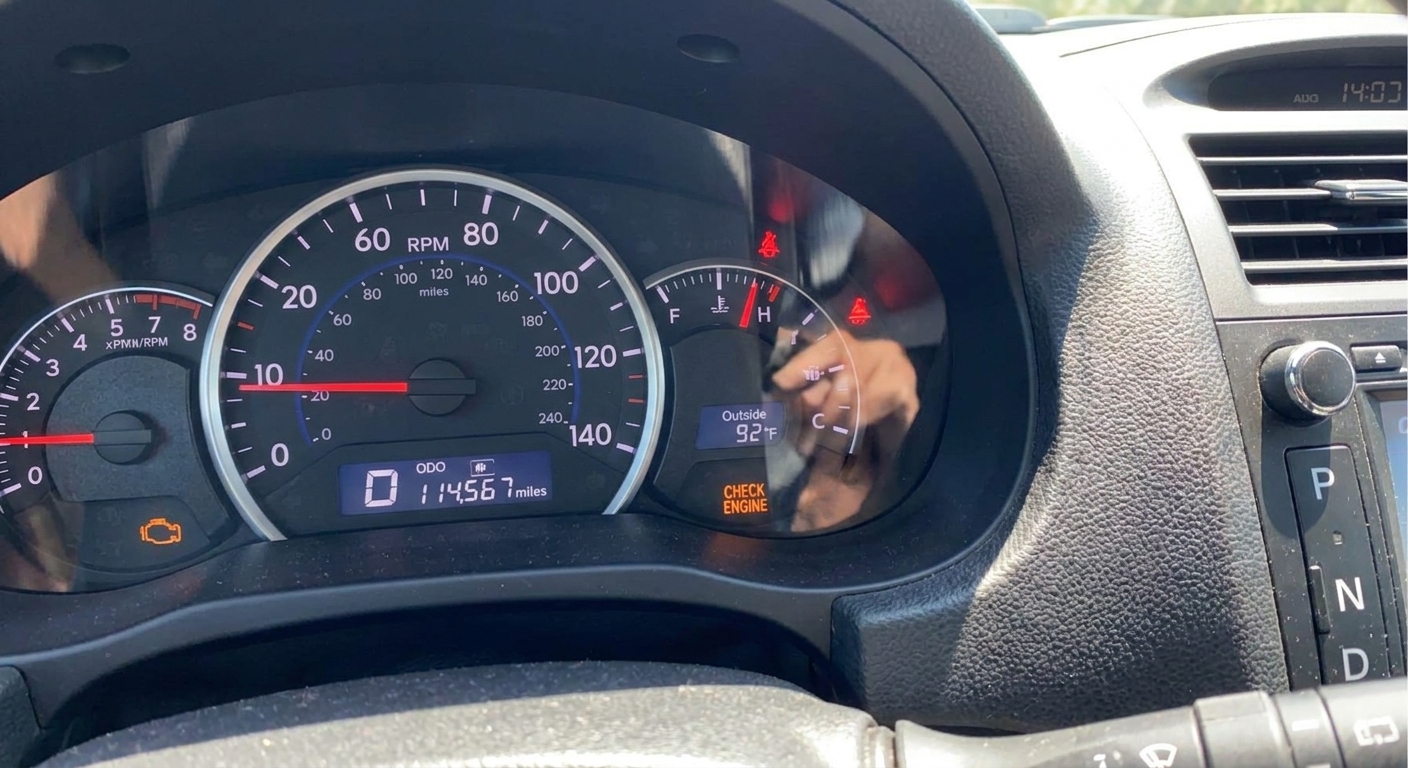
Step 3: Check the gas cap
On many cars, a loose, damaged, or missing gas cap can trigger an EVAP leak code and turn the light on. It is one of the few truly easy fixes.
- Turn the engine off.
- Remove the gas cap and reinstall it until it clicks several times.
- Check the rubber seal for cracks or flattening.
If the cap was loose, it can take a few drive cycles for the light to turn off on its own. A drive cycle is basically a normal run of the car where it warms up and completes self-checks. Clearing the code with a scanner may turn the light off sooner, but if there is still a leak, it will come back.
Step 4: Pull codes with OBD2
If you own a 1996+ vehicle sold in the U.S., it should have an OBD2 port. A simple code reader or a Bluetooth dongle and phone app can tell you what system the car is complaining about. That is information you can use, whether you plan to DIY or go straight to a shop.
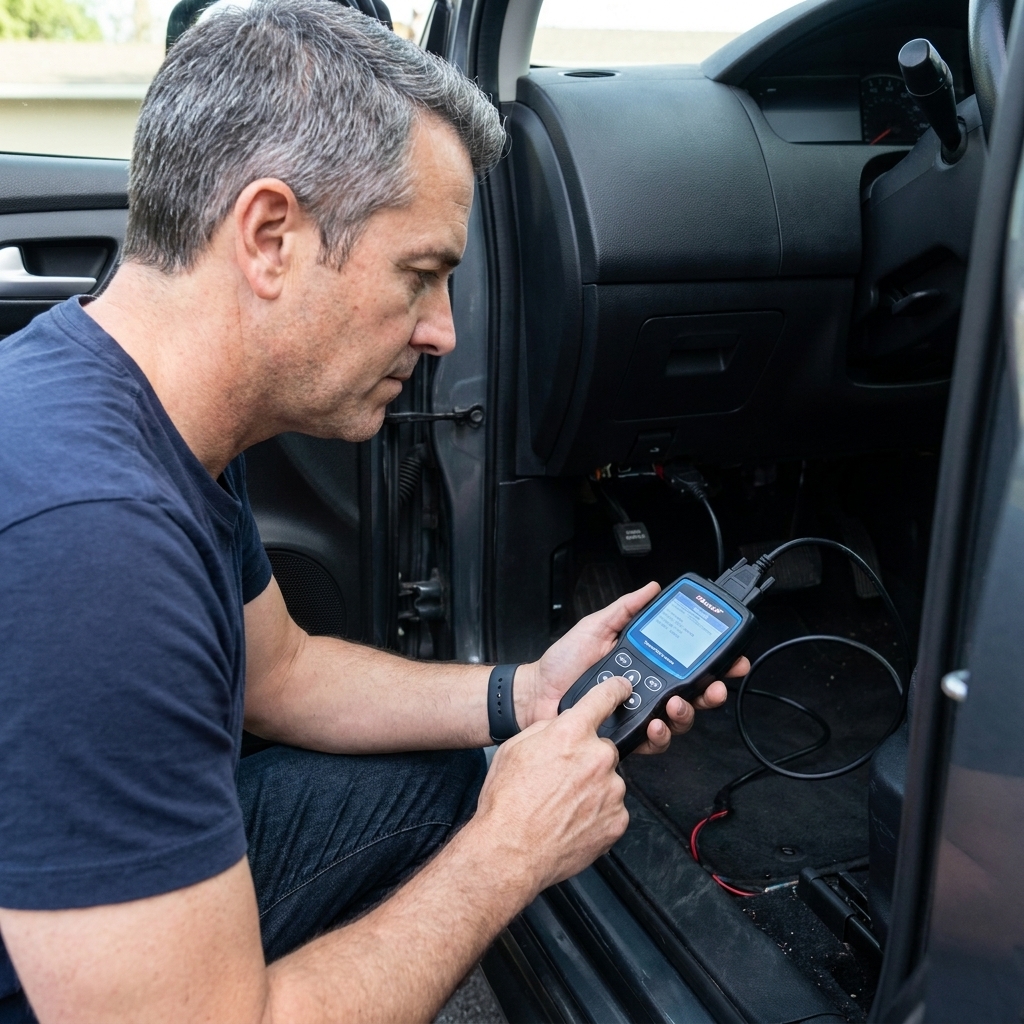
Find the OBD2 port
It is usually under the dash on the driver side, near the steering column, sometimes behind a small trim cover. If you cannot spot it, check your owner’s manual.
Read codes step by step
- Park safely, shift to Park, set the parking brake.
- Plug in the scanner to the OBD2 port.
- Turn the key to ON (or press the start button without starting the engine) unless the scanner instructs otherwise.
- Read codes and write them down exactly (example: P0302).
- Pull freeze frame data if your tool shows it. This is a snapshot of conditions when the fault set (RPM, coolant temp, fuel trims).
- Check “pending” codes too. Pending codes can hint at what is developing before the light stays on.
Important: A code does not automatically mean “replace the part named in the description.” It tells you where the computer saw a problem. Diagnosis is confirming why that problem happened.
One more thing: sometimes a low battery, a weak alternator, or a recent battery disconnect can cause odd warnings or stored codes. It is still worth pulling codes, but do not panic if the car otherwise runs normally.
Step 5: Drive, limp, or tow
Use this as a practical decision tree.
Usually OK to drive (short term)
- Light is solid
- No overheating
- No oil pressure or charging warnings
- Car runs and shifts normally
- No strong fuel smell or loud new mechanical noise
Even here, I recommend avoiding long highway trips until you pull the codes. Drive to a place you can park safely, then diagnose.
Limp to a shop (avoid highways)
- Light is solid, but you notice minor roughness
- Reduced power but still stable
- Transmission feels “stuck” in one gear (some cars go into limp mode)
Keep speeds low, be gentle on the throttle, and minimize driving time.
Stop and tow
- Flashing check engine light
- Temperature gauge rising or overheating warning
- Oil pressure light on, or low oil pressure message
- Car is shaking badly, backfiring, or stalling
- Heavy fuel smell, visible smoke, loud knocking, or any new mechanical noise that worries you
Common codes and next steps
Here are a few of the big ones I see all the time, plus what to do next. Consider these starting points, not a final diagnosis.
P0300, P0301 to P0308: Misfire
- What it suggests: The engine is misfiring (random or on a specific cylinder).
- Common causes: Spark plugs, ignition coils, vacuum leaks, fuel injector issues, low fuel pressure, internal engine problems.
- What to do: If it is flashing or running rough, stop driving. If it is mild and solid, avoid hard acceleration and schedule diagnosis quickly.
P0420, P0430: Catalyst efficiency
- What it suggests: The catalytic converter system is not performing as expected.
- Common causes: Failing catalytic converter, exhaust leaks, engine running rich, aging oxygen sensors, or damage from prolonged misfires.
- What to do: Usually not an immediate “pull over” issue, but do not ignore it. Fix any misfire or fuel trim problem first or you can ruin a new converter. Also, keep in mind that the downstream O2 sensor is part of the test, but it is not always the root cause.
P0171, P0174: System too lean
- What it suggests: The engine is running with too much air or not enough fuel (bank-specific on V engines).
- Common causes: Vacuum leaks, unmetered air after the MAF sensor, weak fuel pump, dirty MAF sensor, PCV issues.
- What to do: Check for cracked intake tubes and loose clamps. If drivability is poor, limit driving and get it checked.
EVAP codes (P0440, P0442, P0455)
- What it suggests: A leak or fault in the fuel vapor system.
- Common causes: Loose gas cap, cracked EVAP hoses, purge valve problems.
- What to do: Start with the gas cap and a visual inspection. Usually safe to drive, but it will not pass emissions testing until repaired.
P0128: Coolant temp too low
- What it suggests: The engine is running cooler than expected.
- Common causes: Thermostat stuck open, coolant temp sensor issues.
- What to do: Not typically an emergency, but it can hurt fuel economy and cabin heat. Fix it before winter if you live somewhere cold.
Should you clear the code?
You can clear codes, but do it with intention.
When clearing makes sense
- You tightened a loose gas cap and want to see if the code returns.
- You are diagnosing and want to see which codes come back after a repair.
When clearing is a bad idea
- You have not written down the codes and freeze frame data.
- You need an emissions test soon. Clearing resets readiness monitors, and many cars need multiple drive cycles before they are “ready” again.
- The car is driving poorly. Clearing does not fix the cause, it just turns off the warning temporarily.
Before you go to a shop
A little prep helps you avoid paying for guesswork.
- Bring the codes: A photo of the scanner screen works.
- Describe symptoms, not theories: “Rough idle at stoplights” is better than “It needs an oxygen sensor.”
- Note conditions: Cold start vs warm, highway vs city, rain or humidity, after fueling, uphill acceleration.
- Ask for the diagnostic path: A good shop can explain what they tested and what evidence pointed to the repair.
Keep a scanner handy
If you drive an older car, road trip often, or just like being prepared, a basic OBD2 scanner is one of the best cheap tools you can own. You do not need a pro-level scan tool to pull codes and freeze frame data.
My advice: pick a reputable scanner that can read pending codes and show live data. Live data like coolant temperature, fuel trims, and misfire counters can turn “I have a code” into “I understand the problem well enough to make a smart next move.”
Quick FAQ
Can I drive with the check engine light on?
If it is solid and the car feels normal, usually yes for a short time, but pull codes soon. If it is flashing or the engine runs rough, treat it as urgent and stop driving as soon as it is safe.
Will the check engine light turn off by itself?
Sometimes. If the problem is corrected, many cars will turn the light off after a few drive cycles. If the underlying issue remains, it will come back.
Is it safe to use a cheap Bluetooth OBD2 dongle?
For reading codes and basic data, generally yes, as long as it is a reputable brand and you use a trusted app. Avoid leaving it plugged in full time if it drains your battery or interferes with vehicle systems.
What if the light came on right after getting gas?
Start by checking the gas cap. If the cap is tight and the light stays on, pull codes. EVAP-related codes are common in this situation, but it is worth confirming.