A complete, mechanic-approved winterizing checklist: battery health, tire traction, correct fluids, wipers, lights, brakes, rust prevention, and a simple eme...
Your tires are the only part of your car that actually touches the road, and the amount of tread you have left affects how well you stop, steer, and evacuate water. I have seen perfectly “fine-looking” tires turn into a white-knuckle ride the moment the rain starts, simply because the tread was worn down past the point where it could do its job.
The good news: you do not need a lift, a shop visit, or a toolbox full of specialty gear to check tread depth. You can get a solid answer in five minutes with a penny, your eyeballs, or a cheap gauge.
What tread depth means
Tread depth is how tall the tread is from the bottom of the main grooves to the top of the tire. Those grooves are not just there for looks. They channel water away so the rubber can stay in contact with the pavement.
New passenger car tires often start around 9/32 inch to 12/32 inch of tread depth (some all-terrain and truck tires can start deeper). As you drive, that number drops.
Why it matters
- Wet traction: Less groove depth means the tire cannot move water fast enough, increasing hydroplaning risk.
- Stopping distance: Worn tires generally take longer to stop, especially on wet roads.
- Snow grip: Snow traction falls off early. If you deal with winter weather, you will often want more tread than the legal minimum.
- Heat and blowout risk: Very worn tires run hotter and are more vulnerable to damage from potholes and road debris.
When to replace by depth
There is the legal limit, and then there is the smart limit. Here is how I explain it in the shop.
| Tread depth | What it means | What I recommend |
|---|---|---|
| 8/32" to 12/32" | Healthy tread | Keep driving, rotate on schedule, watch for uneven wear. |
| 6/32" | Mid-life for many tires | Start paying closer attention, especially before rainy season. |
| 4/32" | Wet performance is dropping | Plan for replacement soon if you see lots of rain. |
| 3/32" | Very limited wet traction | Replace soon. I consider this “on borrowed time” in wet conditions. |
| 2/32" | Legal minimum in many places (including most U.S. states) | Replace now. This is bald for practical purposes. |
If you drive in snow: Many drivers swap winter tires or replace all-seasons around 4/32" because snow traction drops off hard once the sipes and grooves get shallow.
How to measure tread depth
You will get the best answer by checking multiple spots across the tread and on all four tires. Tires can wear unevenly and still “pass” a single quick check in one groove.
Quick rule: Measure in the main grooves (the wide channels), not on the tread blocks themselves, and check more than one groove per tire if you can.
1) The penny test
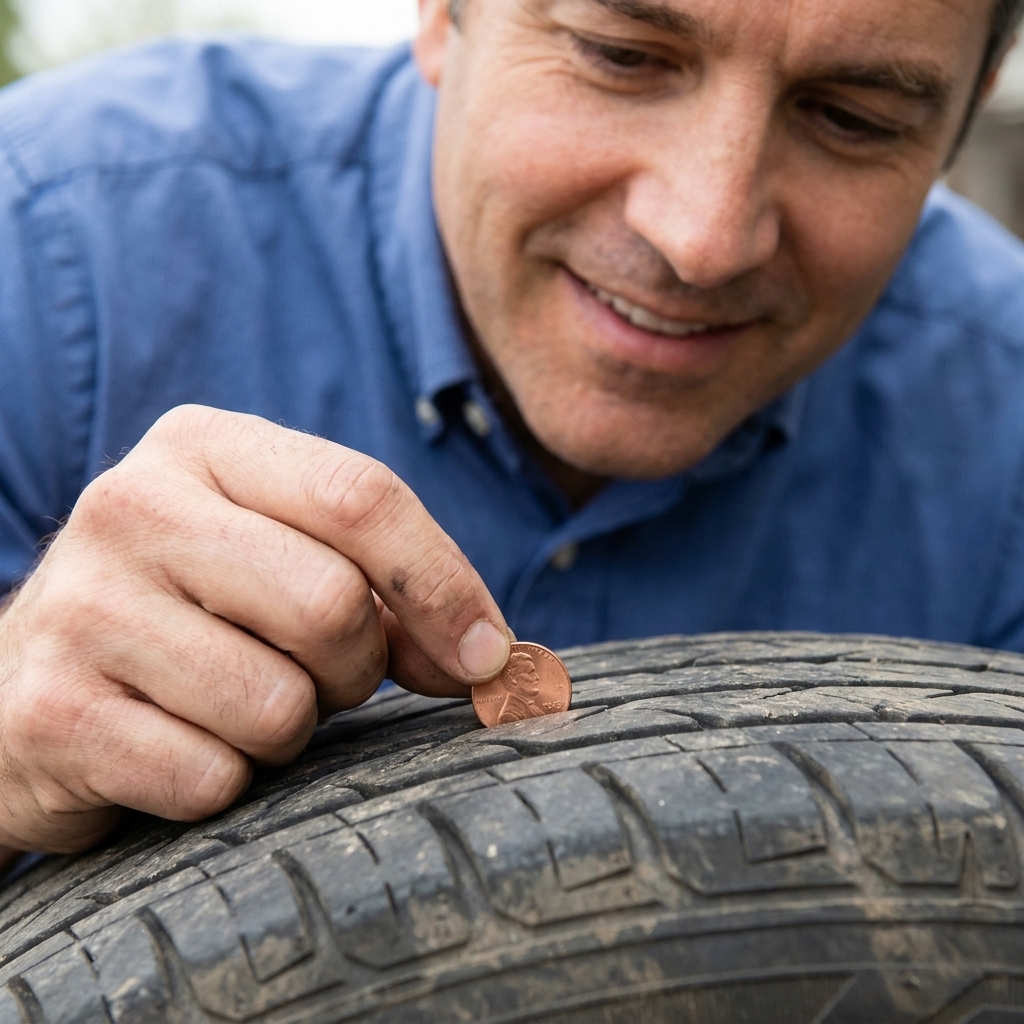
The penny test is a quick screening tool. It does not replace a real measurement, but it will catch dangerously worn tires.
- Park on a flat surface and set the parking brake.
- Pick a main tread groove (one of the wide channels that runs around the tire).
- Insert a penny head-first (Lincoln’s head pointing down into the groove).
- Look at how much of Lincoln’s head is visible.
How to read it: If you can see the top of Lincoln’s head, you are at 2/32 inch or less, which is the “replace now” zone.
2) Wear bars
Virtually all modern road tires have raised bars molded into the tread grooves called tread wear indicators (often called wear bars). When the surrounding tread wears down to the same height as those bars, the tire is at about 2/32 inch.
How to check:
- Turn the steering wheel outward a bit for front tires so you can see the tread face more easily.
- Look down into the main grooves and find the little “bridge” sections across the groove.
- If the tread is flush with the bar, the tire is done.
Pro tip: Wear bars are your legal-limit indicator, not your best-practice indicator. In the rain, a tire can feel sketchy well before it is flush with the bars.
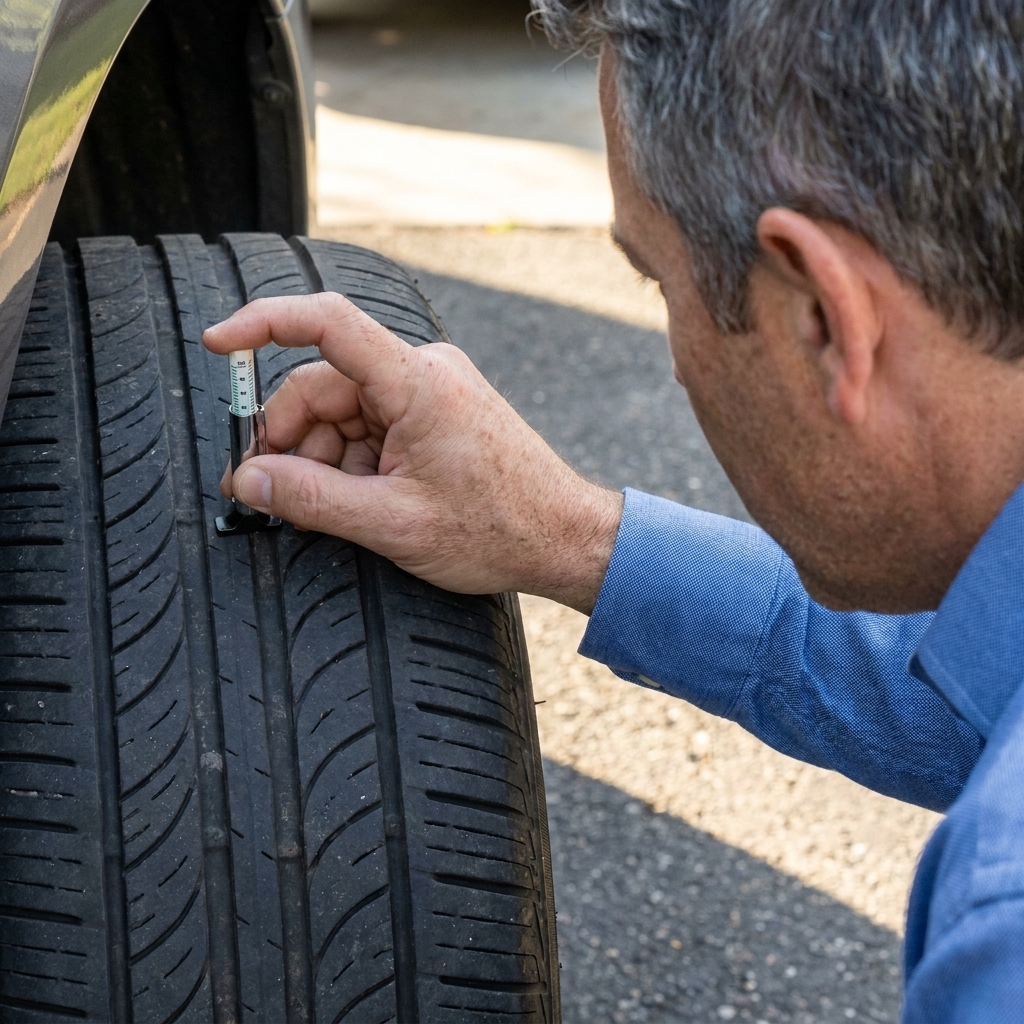
3) A tread depth gauge
If you want a real number, buy a tread depth gauge. The simple pencil-style gauges are inexpensive and work fine. Digital gauges are easy to read, but not required.
How to use a gauge correctly:
- Press the base of the gauge flat against the tread.
- Push the probe down into the deepest part of the groove.
- Read the measurement in 32nds of an inch (for example, 6/32).
- Check at least three spots across the tire: inner edge, center, outer edge.
- Repeat on all four tires, and compare both tires on the same axle.
If one edge is wearing faster than the rest, that is not just a tire problem. It is usually an alignment, inflation, or suspension issue.
Where to measure
I cannot tell you how many times someone has said, “My tires still have tread,” and they do. Just not evenly.
Use this quick routine:
- Front left: inner, center, outer
- Front right: inner, center, outer
- Rear left: inner, center, outer
- Rear right: inner, center, outer
Write the numbers down. If you see big differences across the same tire, you have a wear pattern worth fixing, not just a tire worth replacing.
Wear patterns
Tread depth is the “how much.” Wear patterns are the “why.” Here are the big ones I see.
Worn center
Often points to overinflation. Too much air crowns the tire, so the middle does most of the work.
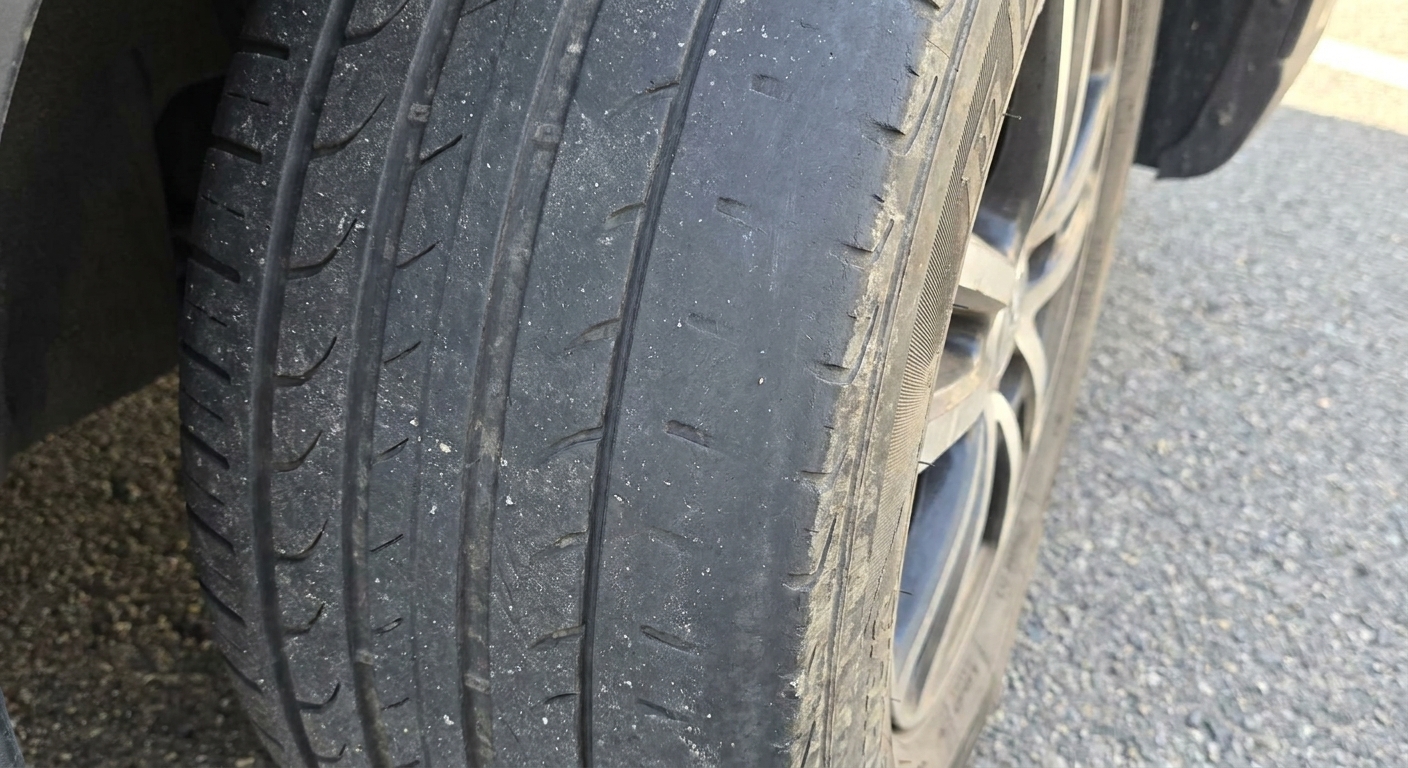
Worn edges
Often points to underinflation. Low pressure makes the shoulders carry the load and build heat.
One edge worn
Classic sign of alignment issues (camber or toe). You can replace tires all day, but they will keep wearing wrong until alignment is corrected.
Cupping
Often linked to worn shocks or struts or suspension play. The tire bounces instead of staying planted.
Feathering
Commonly toe misalignment. You might also notice extra road noise.
Replace even with tread
Tread depth is a huge piece of the safety puzzle, but it is not the whole puzzle. Replace tires sooner if you see any of the following:
- Cracks or dry rot in the sidewall or between tread blocks.
- Bulges or blisters on the sidewall, often from impact damage.
- Repeated air loss that is not explained by a simple nail and repair.
- Vibration that balancing cannot fix, which can indicate internal tire damage.
- Chunks or cords showing. If you can see fabric or steel, stop driving and replace immediately.
Safety note: If you have cords showing or a sidewall bulge, do not gamble on “one more trip.” Put on the spare if you have one or get the car towed.
Tire age
Even with decent tread, old tires can harden and crack. Check the DOT date code on the sidewall (a four-digit number that indicates the week and year of manufacture, like 2622 for week 26 of 2022). Recommendations vary by tire maker and vehicle manufacturer, but a common rule is to inspect more closely as tires pass about 5 to 6 years, and many tires get replaced somewhere around the 6 to 10 year mark depending on condition, climate, and use. When in doubt, follow your tire manufacturer and owner’s manual guidance.
Rain reality check
The legal minimum exists because a line has to be drawn somewhere. But if you regularly drive in heavy rain, 2/32 inch can feel like driving on hard roller skates.
If your tread depth is down around 4/32 inch, you might still pass the penny test, but you are already giving up a noticeable amount of wet traction. That is why I tell friends and family to treat 4/32 as the point to start shopping, not the point to start panicking.
Make tires last
- Check pressure monthly: Use the door-jamb sticker, not the number on the tire sidewall.
- Rotate regularly: Many cars do well with rotations around every 5,000 to 7,500 miles, or at each oil change interval if that is easier to remember.
- Align when you buy tires: If your old set wore unevenly, do not “hope” the new ones do better.
- Fix suspension issues: Worn components eat tread fast and can make the car feel unstable.
- Drive smoothly: Hard launches, panic braking, and aggressive cornering all cost you tread.
FAQ
Penny or quarter test?
The penny test flags the legal-minimum area (around 2/32 inch). The quarter test is a more conservative check: if you insert a quarter with Washington’s head down and you can see the top of his head, you are roughly at 4/32 inch or less. Either way, a tread depth gauge is the most accurate and removes the guesswork.
Replace all four at once?
Not always, but you want tread depths to be reasonably close side-to-side on the same axle. If you drive an AWD vehicle, mismatched tread depths can stress the drivetrain on some systems. Check your owner’s manual for guidance. Many manufacturers specify a maximum allowable difference, often expressed in 32nds of an inch or as a circumference difference, and it is worth following that spec.
Tread looks fine, but it slides in rain
Common causes include low tread depth (especially under 4/32), improper inflation, old hardened rubber, or a cheap tire that was never great in the wet to begin with. Standing water and speed matter too. Even good tires can hydroplane if conditions are right.
Measure without kneeling?
You can usually get a decent look at front tires by turning the steering wheel full lock. For the most accurate readings, you will still want to measure at multiple points, which usually means getting down there with a gauge.
Bottom line
If you take one thing from this: do not wait for tires to look bald. Check tread depth a few times a year, especially before winter and rainy season. Use the penny test as a quick screening tool, use wear bars as a hard stop, and keep a tread depth gauge in your glovebox if you want numbers you can trust.
Your brakes can be perfect, your shocks can be new, and your car can have every modern safety system in the world. If the tires cannot grip, none of it matters.